Table Of Contents
- What is Flow Wrap?
- What are VFFS and HFFS?
- How does a flow wrap machine work?
- Flow Wrapping Applications
- Can you use a flow wrapping machine to pack liquids?
- Flow Packaging Types
- Why use Flowpack packaging?
- Limitations of flow wrapper packaging
- Flow Pack Packaging Material Types
- How long does flow wrap take?
- How much money can you save by using a flaw wrap?
Flow Wrap Packaging Ultimate Guides
Last Updated on September 15, 2026
Reading Time 15 Minutes
This blog will guide you through all aspects of flow wrap, helping you choose the right flow wrap packaging for your product.
Don’t let packaging become a stumbling block to your business growth!
What is Flow Wrap?

Flow pack is a high‑efficiency, cost‑effective packaging method that uses plastic roll film and automatic packaging machines.
The product goes through a series of steps and finally gets packed. Since the whole process runs like a production line, it’s called flow wrapping.
What are VFFS and HFFS?
People also call a flow wrapper a form fill seal machine. Based on the direction of film unwinding, they are divided into VFFS and HFFS.
VFFS machine (Vertical Form‑Fill‑Seal) is the most widely used automatic packaging machine.
The machine feeds the film roll straight down vertically. First, it folds the film into a tube shape and does the longitudinal heat seal. Once the product drops inside the tube, cross‑sealing and cutting happen next.
Your products fall into the bag by gravity from above. Vertical form fill and seal machines work great for powders, granules, bulk materials and liquids.
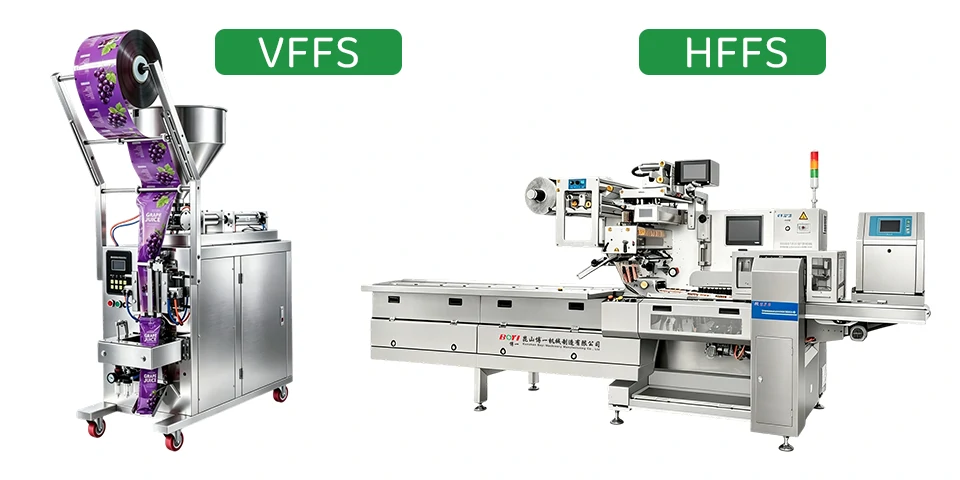
HFFS machine (horizontal Form‑Fill‑Seal) works best for packing individual solid items. The horizontal flow wrap machine wraps the product instead of pouring it into a pouch.
The film roll feeds forward horizontally and forms into a tube. A mechanism pushes the products sideways into this film tube. Then the machine makes the back seal, heat-seals and cuts both ends, creating pillow-style bags.
| Item | HFFS | VFFS |
|---|---|---|
| Film feeding direction | Horizontal | Vertically downward |
| Product feeding method | Solid items are fed horizontally into the film tube | Powders / granules fall vertically into bags by gravity |
| Typical products | Biscuits, candies, soap | Dog food, coffee beans, powder, cat litter |
| Bag styles | Pillow packs mainly | Pillow bags, 3-side seal bags, gusseted bags, etc. |
How does a flow wrap machine work?
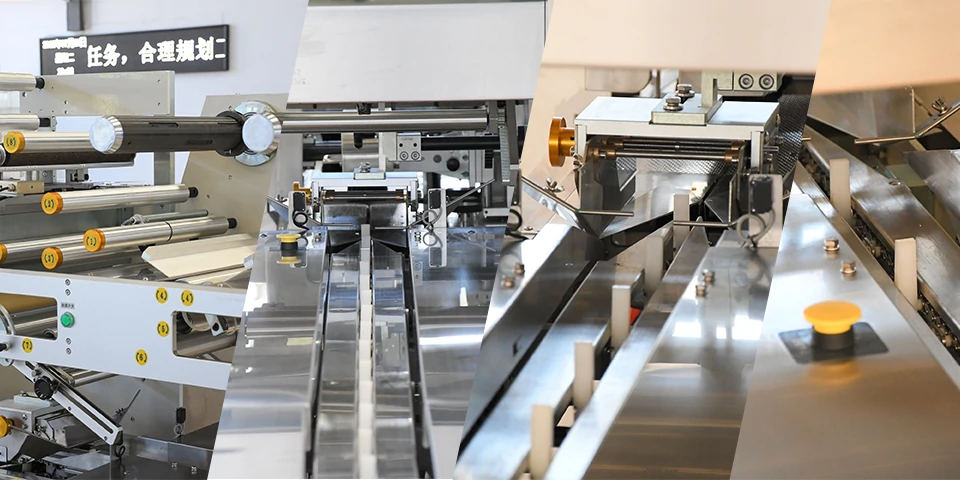
Both HFFS and VFFS follow the same core steps to pack a product; take the HFFS flow wrapper machine as an example:
Step 1: Film Unwind. The packaging film roll is loaded onto the film unwinding rack, and the film is pulled out by the traction rollers.
Step 2: Product Infeed. The product is manually (or by a feeding machine) placed on the conveyor belt. Stops separate the products at fixed intervals, sensors detect the product position, and the product conveying speed and film feeding speed are synchronized.
Step 3: Forming Tube. The product moves to the forming shoulder. Here, the flat film gets folded and wrapped around the item, turning the flat sheet into a continuous tube. The two long sides of the film overlap underneath the product.
Step 4: Longitudinal Seal. Those overlapping film edges run through heated longitudinal seal rollers. Heat and pressure fuse the two film layers together to create a steady back fin seal. This seals up the tube to hold the product inside, while the conveyor keeps moving forward.
Step 5: Cross Seal & Cutting. The bottom of the finished pouch and the top of the next one get heat-sealed at the same time. A cutter then slices right through the seal, separating the continuous tube into standalone individual packages.
Step 6: Discharge. The sealed and cut pillowcases are conveyed out by a conveyor belt.
Flow Wrapping Applications
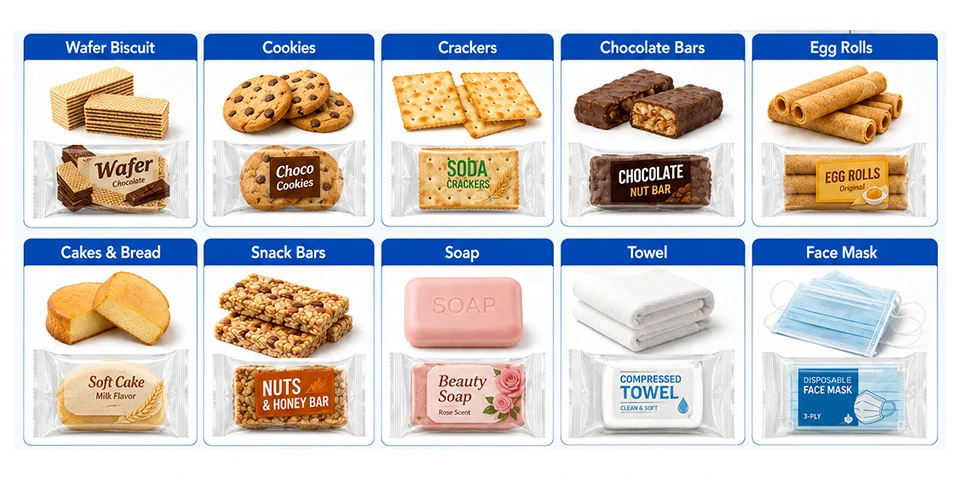
Food industry
Baked pastries, cookies, chocolate, candies, energy bars, potato chips, coffee beans, grains, nuts, frozen foods, ice cream bars. You can use cold-seal film for heat-sensitive items.
Medical supplies industry
Disposable face masks, syringes, blood collection needles, medical dressings, and sterile swabs. It supports clean packaging and tamper-proof seals.
Personal care & cosmetics industry
Bar soap, disposable towels, and wash powders. Recyclable or biodegradable materials make packaging bags, protect the environment, and comply with laws and regulations.
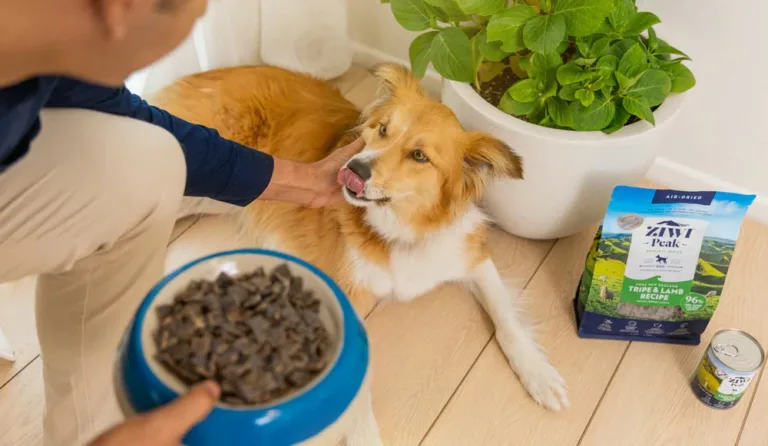
Pet products industry: Dog food, cat litter, pet chew sticks, dental treats, small pet toys.
Stationery industry: Erasers, glue sticks, crayons.
Household supplies industry: cleaning sponges, fragrance blocks, outer pouches for laundry pods.
Agricultural seed industry: Vegetable seeds, flower seeds.
Need Custom Flow Wrap Packaging?
Can you use a flow wrapping machine to pack liquids?
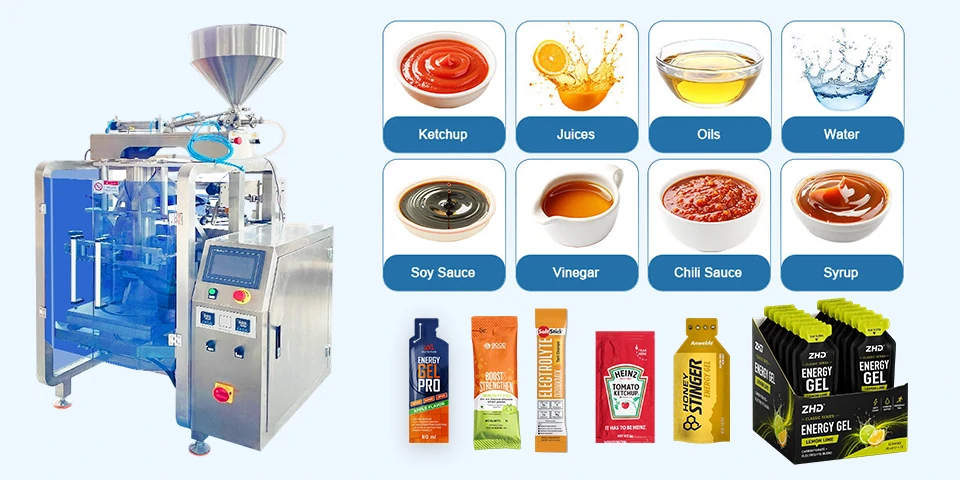
Yes, VFFS machines can pack liquids.
But you need to use special components including piston pumps, anti-drip nozzles and reinforced sealing jaws to stop leaks.
It works great for small sachets like honey, sauces, shampoo samples and cat treats. But VFFS is only good for small-volume packages, typically no more than 60ml.
By using die-cut shape molds, manufacturers can make packaging bags in various shapes.
Flow Packaging Types
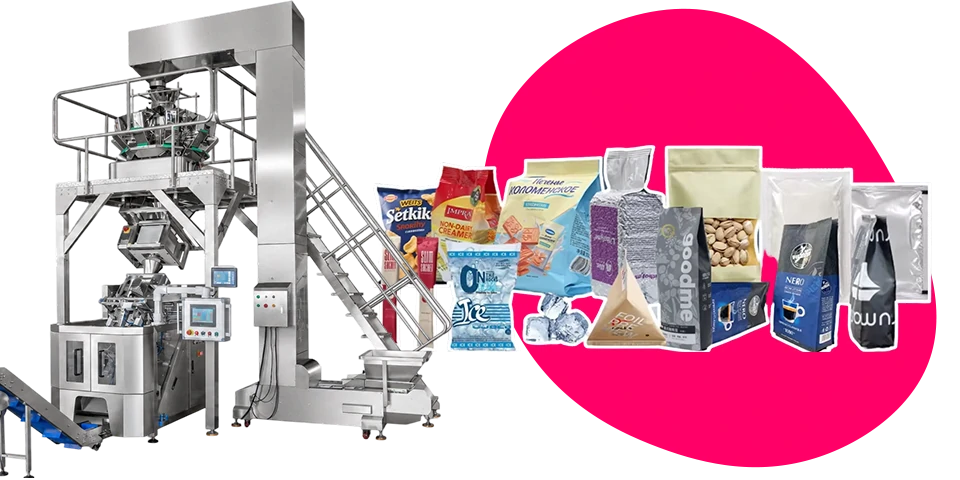
Pillow bag
Roll film is folded into a tube and sealed along the back. Products go inside, then both ends get sealed and cut, forming a pillow-shaped pack.
3-side seal sachet
Film folds in half. Left and right edges are sealed. Fill product from top, then seal the top edge, leaving three sealed sides total.
Gusseted bag
Fold extra creases on both sides of the film while running. Once filled, the side folds expand to give the bag extra width.
Stick pack
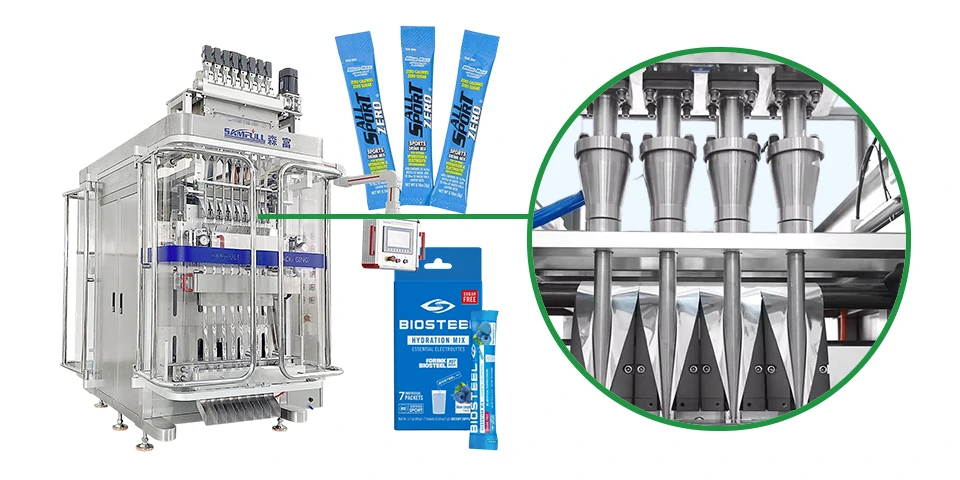
Multiple narrow film strips run down. Longitudinal seals make thin tubes. After filling, cross seals cut them into slim single-serve sticks. Can use multiple channels to improve efficiency.
Shaped pouch
After sealing the pouch, a die cutter trims it into custom curved or irregular outlines. This is a flowpack packaging solution.
Vacuum bag
VFFS forms the bag and fills the product. Before fully closing, the bag sucks out the air inside, then it seals quickly to hold the vacuum.
Stand-up pouch (Doypack)
Film folds and seals to create a folded bottom panel. When filled, this base opens up so the pouch stands firmly on shelves.
MAP bag
(Modified Atmosphere Packaging) After forming and filling the bag, old air is removed. Custom mixed protective gases are injected, then the pouch seals fast to slow food spoilage.
Why use Flowpack packaging?
Lower material cost
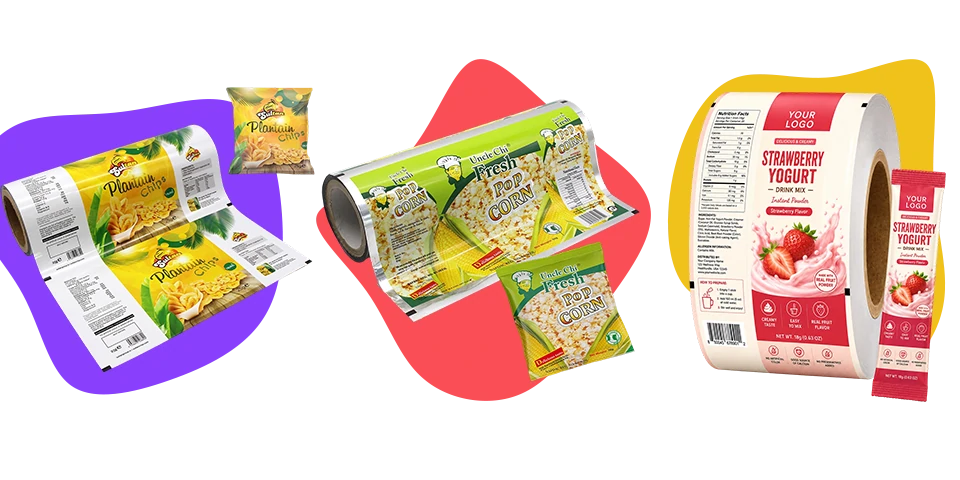
It uses film rolls directly, rather than pre-made pouches which cost much more.
Lower packaging costs
You only need one skilled technician to keep the machine up and running. Machines for pre-made pouches, on the other hand, need plenty of workers just for filling and heat sealing.
Better efficiency
The machine can churn out thousands of packs every hour. A horizontal flow wrapper can run nonstop 24/7—you only need to change film rolls once in a while, so there’s minimal downtime.
Pre-made bag machines constantly need fresh empty pouches loaded in, which leads to frequent short stops.
Integrated functions
You can easily fit modules for weighing, coding, hole punching, tear notches, gas valves, degassing, nitrogen flushing (MAP), and vacuum sealing. The whole line finishes everything in one go, no secondary processing needed.
Improved hygiene
Everything runs automatically in a continuous cycle. From forming the pouch, filling the product, all the way to sealing and cutting, people barely touch the items.
This fits the strict hygiene requirements for food and medical goods and lowers the chance of contamination.
Limitations of flow wrapper packaging
High minimum order quantity: Custom printed roll film is required, so small orders don’t make economic sense. Plate costs for printing are pretty high.
Limited pouch styles: Most flow wrappers can’t handle complex structures like pouches with spouts, zippers or flat-bottom bags.
High equipment investment: VFFS and HFFS machines come with a big price tag. You also need trained staff for setup and maintenance.
Troublesome sampling: You need printed roll film just to test the machine. That means longer lead times for samples, and small sample runs cost more.
Flow Pack Packaging Material Types
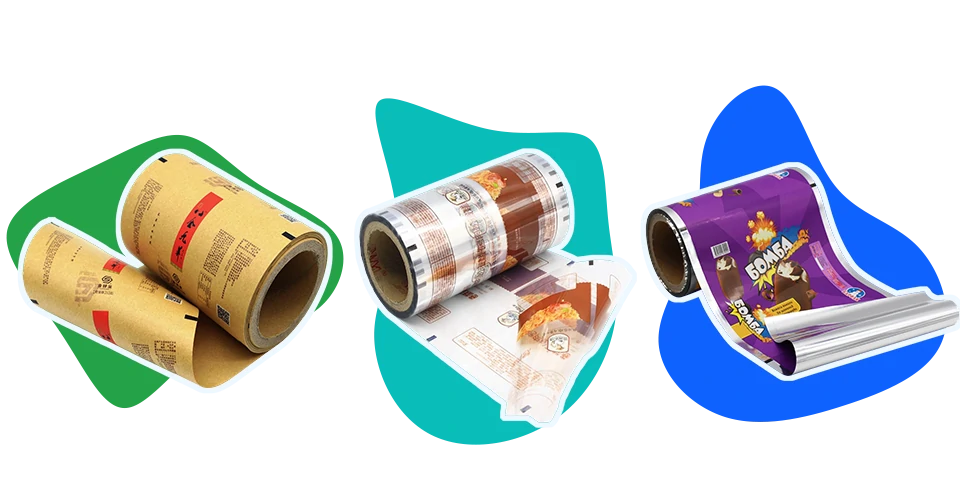
Roll stock films for HFFS and VFFS are supplied on large rolls, usually multi-layer laminates. Outer layers offer stiffness and great printing, while inner layers are designed for heat sealing.
BOPP/CPP: Clear, glossy and low-cost. It is the main film for HFFS flow wrap, for biscuits, candy and soap. It works on VFFS for dry snacks, but oxygen barrier is limited.
PET/PE: The most common VFFS laminate. PET gives sharp printing; PE creates stable seals. Good for nuts, grain and dry pet food.
PET/VMPET/PE: Metallized film with strong moisture & oxygen barrier, blocks light. Great for coffee, powder and long shelf dry goods.
PET/AL/PE: Full aluminium foil laminate. Top-level barrier, fully light-proof. Used for spices and light-sensitive products.
PET/Nylon/PE: Puncture-resistant, oil-proof and freezer-safe. Ideal for frozen food, jerky, VFFS vacuum and MAP bags.
Cold seal film: Made specially for HFFS flow wrap. Bonds under pressure with no heat, perfect for chocolate to prevent melting.
Paper/PE : Natural kraft look. Fit for bakery goods, though moisture barrier is weak.
Single-layer PE: Cheap and flexible for simple lightweight packs, but poor print and barrier performance.
Mono material PE: This film is built entirely from polyethylene, so it is fully recyclable within standard PE recycling streams and meets PPWR rules. It seals well and works on both VFFS and HFFS. Great for pet food, nuts and frozen goods
Have Questions About Material?
How long does flow wrap take?
| Flow Wrapper | Type | Typical Speed (bags/min) |
|---|---|---|
| VFFS | intermittent motion | 20–50 |
| VFFS | continuous motion | 40–100 |
| VFFS | high-speed servo continuous motion |
80–150 |
| VFFS | Multi-lane high-speed servo continuous motion |
150–500+ |
| VFFS | High End (e.g., Syntegon SVX) | 300/lane 600 (twin-lane paired) |
| HFFS | continuous motion | 60–230 |
| HFFS | single-lane high-speed servo continuous |
300–400 |
Packaging speed of flow wrap machines mainly depends on five factors.
Motion type
Intermittent Motion: The roll film stops moving. Filling, sealing and cutting only happen while the film is stationary.
Continuous Motion: The film keeps moving at a constant speed all the time. Filling, sealing and cutting take place simultaneously as it runs.
Number of lanes
Single-lane VFFS usually runs at 30–150 packs per minute. Multi-lane setups boost total output to over 500 packs per minute.
Pouch size & style
Small pouches run faster than large ones. Gusseted or custom-shaped pouches are slower than regular pillow bags.
Filling system
Your maximum packaging speed is limited by how fast your feeder can discharge product. Multi-head feeders help raise throughput.
Conveying direction
For HFFS, products travel horizontally on a conveyor belt. Speed is controlled by the belt and can get really high. For VFFS, products drop into pouches by gravity, so speed is capped by gravitational acceleration.
How much money can you save by using a flaw wrap?
| Tier | Price Range (USD) | Typical Speed | Features | Brands |
|---|---|---|---|---|
| Basic | $3,000–15,000 | 5–40 bags/min | Pneumatic / compact servo, intermittent motion, simple pillow bags, Small Size |
Dession Jochamp |
| Popular | $15,000–40,000 | 30–80 bags/min | Servo-driven, PLC touchscreen, Continuous Motion, Pillow bags or Gusseted Bags, Medium / Large Bag size |
Lintyco Kefai |
| High-end | $40,000–100,000 | 80–180+ bags/min | high-speed servo Continuous motion multi-lane or large bags Fully integrated lines |
Soontact Ilapak |
| Famous Brand | $100,000+ | 150–300+ bags/min | Super High Speed & All features of High-end flow wrapper |
Syntegon TNA |
Once your production reaches a certain scale, flow wrap can boost your output and slash your costs big time. Let’s run the numbers for you below.
Flow Wrapper Cost
Generally speaking, bigger machines mean faster packaging speeds, support for larger pouches and more optional attachments. That’s why checking machine size is the quickest way to estimate its price. The table below breaks down the machine price ranges in detail.
Film Roll Stock Cost
Take the common back-seal pouch as an example: pre-made pouches cost 3 to 5 times more than using roll film with a flow wrapper. Pre-made bags are formed, cut and manually handled at the pouch factory. Labor, production and admin expenses there create this price gap.
Let’s do simple math. Say you need to pack 1,000,000 bags a year. With basic plastic material, roll film only costs $10,000, while pre-made pouches run from $30,000 to $50,000. If you go with metallized film, the difference in packaging material costs gets even bigger.
Labor Cost
Flow wrap can cut your costs drastically. Let’s break it down for the filling and sealing steps.
Suppose one worker handles filling and another does sealing, with an average salary of $35,000 per person each year.
Your annual output is 1 million bags, so you need 500 bags per hour (1,000,000 / 250 days / 8 hours). That’s pretty much the maximum one person can manage, and you’ll pay $70,000 a year for these two workers.
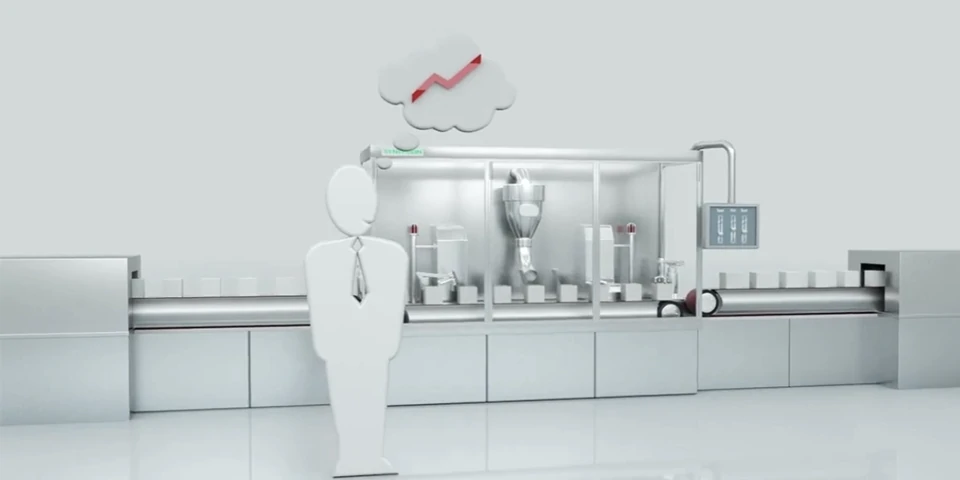
If you switch to use a flow wrapper, you only need one technician to oversee 3 to 4 roll-film machines. You just cover the salary for that single staff member.
To wrap it up:
packing one million units with a flow wrapper can save you at least $40,000.
Basic flow wrapper: -$15,000
Savings from roll film: +$20,000
Labor cost savings: +$35,000
Frequent Ask Question
Select a category below to view related questions and answers
What's MOQ of custom flow wrap Packaging?
MOQ 1 roll and you can get better price if order more.
Can MOQ devided into different designs?
Yes, however, this is on the premise that the bag size and material must be the same.
Can I get a sample with my design?
Yes, custom printed sample is available
Is printing proof available before Bulk production?
Yes, the printing proof will be ready 7 days later than order date.
What format of artwork do you need?
Illustrator or PDF, please make sure they're editable instead of a texture.
What Our Clients Say
I am very happy with our purchase! It’s exactly what we wanted. We will be using them again for future orders.
Leo Carter
United States
Excellent supplier and very good service. The customized packaging was exactly how I requested and the quality was great. Communication was fast and clear during the whole process. Products arrived on time and were well packed. Very professional and reliable seller. I am very happy and will order again. Highly recommended!
Mia Robinson
Canada
MakePac was amazing to work with. Super quick to respond, really patient with all my questions and very kind!
The pouch bags turned out exactly as described. No issues at all. Production was fast, delivery was quicker than expected and the quality is honestly excellent. Would recommend this company and will definitly be purchasing again 🙂
Sophia Lewis
Australia
I have been working with MakePac for a long time now, and I cannot recommend them highly enough. They are consistently professional, reliable, and always finds solutions to any challenges that arise.
Emma Walker
United States
Thank you to the seller for the care and professionalism — highly appreciated! My requirements were fully met, and the order was completed successfully.
I’m very satisfied with the cooperation. The process was smooth and efficient, with no difficulties at all. Everything worked perfectly.
Ava Hall
Canada
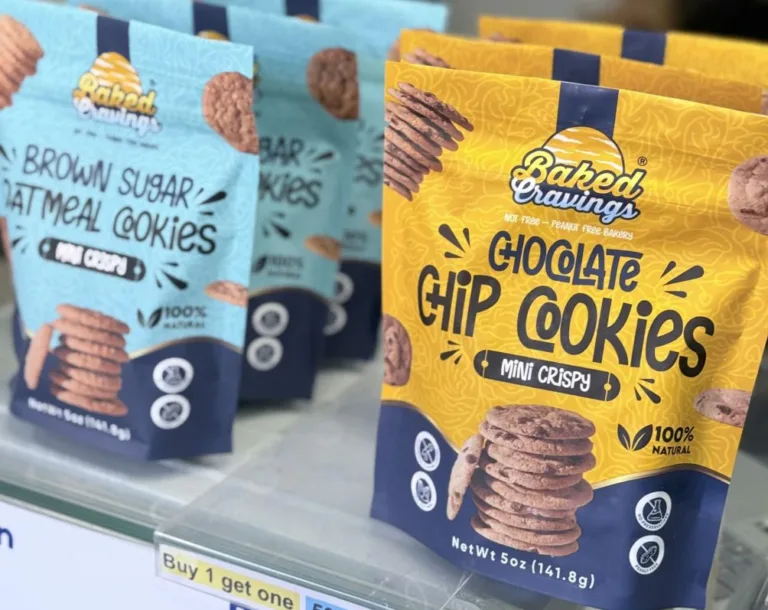
Absolutely amazing services! great communication and even BETTER quality bags 🙂
Highly recommend for any business out there!
Lucas Harris
United Kingdom
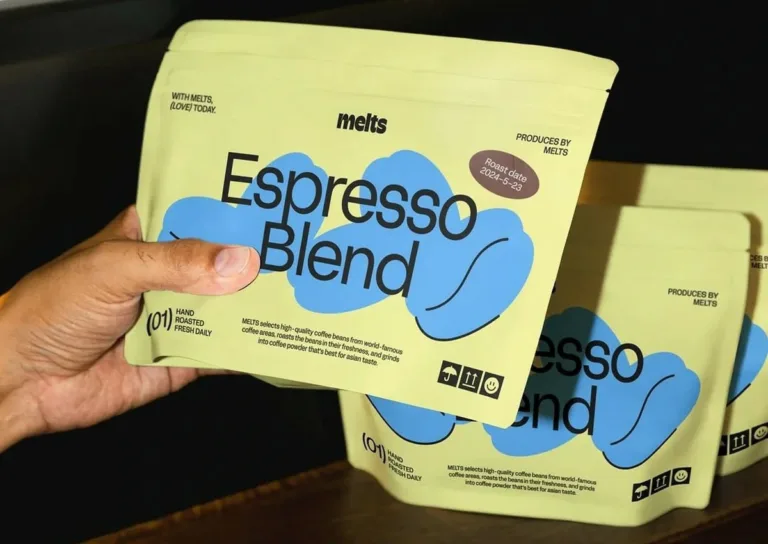
This company delivered my product in emphatic style. from the vision to the finished product. jus wow. it has blown my mind. I was going for a shelf killer. when you see the shelf when my product is on there next to all the other massive brands.
Oliver Martin
Germany